Publication
Discover how we unravel the neural mechanisms of social behavior in
Drosophila melanogaster

Featured publications
RESEARCH ARTICLE
Science Advances - 2026
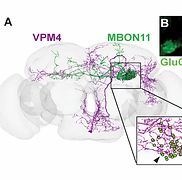
An octopamine-glutamate co-transmitting neuron gates aggressive escalation through layered inhibition in Drosophila
A Prunier*, LM Sherer*, M Da Silva, S Chong, L Bihl, RS Stowers,
SJ Certel* and S Trannoy*
-
We uncover a layered inhibitory circuit in which octopamine-glutamate co-transmission and GABAergic feedback cooperate to prevent excessive aggressive escalation.
-
Our findings reveal that aggressive escalation is actively controlled by layered inhibition rather than simply driven by excitatory mechanisms.
RESEARCH ARTICLE
Elife - 2025

Selection for male aggression is associated with changes in reproductive traits, chemical signaling and lifespan in Drosophila melanogaster
A Defert, R Gout, G Pennot, F Jamme, A Castex,
A Handjar, T Guilleman, JC Billeter and
S Trannoy
-
We show that selection for male aggression alters chemical communication and reallocates fitness investment from reproduction toward survival.
-
Our study reveals that selection for aggression can drive coordinated changes in reproductive behavior, chemical signaling, and lifespan through a life-history trade-off.
Other publications
Learning from fights: Males' social dominance status impact reproductive success in Drosophila melanogaster - pdf
Prunier A, Trannoy S.
PLoS One. 2024 Mar 7;19(3):e0299839.
doi: 10.1371/journal.pone.0299839. PMID: 38452142; PMCID: PMC10919672.
-
We show that previous defeat reduces male reproductive success by decreasing territoriality and courtship motivation, particularly under competition.
RESEARCH ARTICLE

Comparing Methods for Quantifying and Analyzing Drosophila Aggression - pdf
Trannoy S, Paz Fernandez M and Certel SJ
Cold Spring Harb Protoc. Sep 1;2023(9):685-692
doi: 10.1101/pdb.prot108144. PMID: 37019607.
-
We present and compare three complementary assays for studying Drosophila aggression, highlighting how experimental design influences the aggressive behaviors being measured.

REVIEW
Fighting Flies: Quantifying and Analyzing Drosophila Aggression - pdf
Paz Fernandez M, Trannoy S and Certel SJ
Cold Spring Harb Protoc. Sep 1;2023(9):618-627.
doi: 10.1101/pdb.top107985. PMID: 37019610.
-
We summarize how studies in Drosophila have advanced our understanding of the neural circuits, neuromodulators, and internal states that control aggression.
REVIEW

Long-term dietary restriction leads to development of alternative fighting strategies - pdf
Legros J, Tang G, Gautrais J, Paz Fernandez M and Trannoy S
Front. Behav. Neurosci. 2021 Jan 14:599676
doi: 10.3389/fnbeh.2020.599676
-
We show that long-term dietary history shapes aggressive behavior by promoting distinct fighting strategies in Drosophila.
RESEARCH ARTICLE

Aggression and courtship differences found in Drosophila melanogaster from two different microclimates at Evolution Canyon, Israel. - pdf
Palavicino-Maggio CB*, Trannoy S*, Holton KM, Song X, Li K, Nevo E.
Sci Rep. 2019 Mar 11;9(1):4084.
doi: 10.1038/s41598-019-40701-8.
-
We show that adaptation to contrasting microclimates shapes aggression and courtship behaviors, promoting distinct behavioral strategies in wild Drosophila.
RESEARCH ARTICLE

Upregulated energy metabolism in the Drosophila mushroom body is the trigger for long-term memory. - pdf
Plaçais PY, de Tredern É, Scheunemann L, Trannoy S, Goguel V, Han KA,
Isabel G, Preat T.
Nat Commun. 2017 Jun 5;8:15510.
doi: 10.1038/ncomms15510.
-
We demonstrate that dopamine-dependent energy metabolism in the mushroom body is both necessary and sufficient for long-term memory formation.
RESEARCH ARTICLE

Strategy changes in subsequent fights as consequences of winning and losing in fruit fly fights. - pdf
Trannoy S, Kravitz EA.
Fly (Austin). 2017 Apr 3;11(2):129-138. doi: 10.1080/19336934.2016.1259041.
-
We show that previous fighting experience shapes future fighting strategies through winner and loser effects and suggest a role for individual recognition in aggression.
RESEARCH ARTICLE

Short and long-lasting behavioral consequences of agonistic encounters between male Drosophila melanogaster. - pdf
Trannoy S, Penn J, Lucey K, Popovic D, Kravitz EA.
Proc Natl Acad Sci U S A. 2016 Apr 26;113(17):4818-23.
doi: 10.1073/pnas.1520953113.
-
We demonstrate that victories and defeats induce distinct experience-dependent memories, with only repeated defeats producing protein synthesis-dependent long-term behavioral changes.
RESEARCH ARTICLE

A New Approach that Eliminates Handling for Studying Aggression and the "Loser" Effect in Drosophila melanogaster. - pdf
Trannoy S, Chowdhury B, Kravitz EA.
J Vis Exp. 2015 Dec 30;(106):e53395.
doi: 10.3791/53395
-
We developed a handling-free behavioral assay that enables reliable investigation of aggression and experience-dependent learning and memory in Drosophila.
PROTOCOLE

Two independent mushroom body output circuits retrieve the six discrete components of Drosophila aversive memory. - pdf
Bouzaiane E, Trannoy S, Scheunemann L, Plaçais PY, Preat T.
Cell Rep. 2015 May 26;11(8):1280-92.
doi: 10.1016/j.celrep.2015.04.044.
-
We identify a dedicated mushroom body output pathway for short-term memory retrieval and reveal that memory is organized into six distinct phases.
RESEARCH ARTICLE

Learning and memory during aggression in Drosophila: handling affects aggression and the formation of a "loser" effect. - pdf
Trannoy S, Kravitz EA.
J Nat Sci. 2015;1(3):e56.
-
We demonstrate that eliminating handling artifacts reveals robust experience-dependent aggression, including reliable loser and winner effects in Drosophila.
RESEARCH REVIEW

Handling alters aggression and "loser" effect formation in Drosophila melanogaster. - pdf
Trannoy S, Chowdhury B, Kravitz EA.
Learn Mem. 2015 Jan 15;22(2):64-8.
doi: 10.1101/lm.036418.114.
-
We demonstrate that eliminating handling artifacts enables reliable measurement of experience-dependent aggression, including robust loser and winner effects in Drosophila.
RESEARCH ARTICLE

Two pairs of mushroom body efferent neurons are required for appetitive long-term memory retrieval in Drosophila. - pdf
Plaçais PY*, Trannoy S*, Friedrich AB, Tanimoto H, Preat T.
Cell Rep. 2013 Nov 14;5(3):769-80.
doi: 10.1016/j.celrep.2013.09.032.
-
We identify the MB-V3 neurons as a dedicated output pathway for appetitive long-term memory retrieval, supporting parallel processing of short- and long-term memory.
RESEARCH ARTICLE

Mushroom body neuronal remodelling is necessary for short-term but not for long-term courtship memory in Drosophila. - pdf
Redt-Clouet C, Trannoy S, Boulanger A, Tokmatcheva E,
Savvateeva-Popova E, Parmentier ML, Preat T, Dura JM.
Eur J Neurosci. 2012 Jun;35(11):1684-91.
doi: 10.1111/j.1460-9568.2012.08103.x.
-
We demonstrate that developmental pruning of mushroom body neurons is required for adult short-term, but not long-term, memory, supporting parallel memory pathways.
RESEARCH ARTICLE

Slow oscillations in two pairs of dopaminergic neurons gate long-term memory formation in Drosophila. - pdf
Plaçais PY*, Trannoy S*, Isabel G*, Aso Y, Siwanowicz I, Belliart-Guérin G,
Vernier P, Birman S, Tanimoto H, Preat T.
Nat Neurosci. 2012 Feb 26;15(4):592-9.
doi: 10.1038/nn.3055.
-
We identify dopaminergic neurons as a switch that gates long-term memory formation by regulating the balance between long-term and anesthesia-resistant memory.
RESEARCH ARTICLE

Parallel processing of appetitive short- and long-term memories in Drosophila. - pdf
Trannoy S, Redt-Clouet C, Dura JM, Preat T.
Curr Biol. 2011 Oct 11;21(19):1647-53.
doi: 10.1016/j.cub.2011.08.032.
-
We demonstrate that appetitive short- and long-term memories are formed independently in parallel through distinct mushroom body circuits.
RESEARCH ARTICLE

Mushroom body efferent neurons responsible for aversive olfactory memory retrieval in Drosophila. - pdf
Séjourné J, Plaçais PY, Aso Y, Siwanowicz I, Trannoy S, Thoma V, Tedjakumala SR,
Rubin GM, Tchénio P, Ito K, Isabel G, Tanimoto H, Preat T.
Nat Neurosci. 2011 Jun 19;14(7):903-10.
doi: 10.1038/nn.2846.
-
We identify MB-V2 neurons as the mushroom body output pathway that mediates aversive olfactory memory retrieval.
RESEARCH ARTICLE

The steroid hormone receptor EcR finely modulates Drosophila lifespan during adulthood in a sex-specific manner. - pdf
Tricoire H, Battisti V, Trannoy S, Lasbleiz C, Pret AM, Monnier V.
Mech Ageing Dev. 2009 Aug;130(8):547-52.
doi: 10.1016/j.mad.2009.05.004.
-
We demonstrate that ecdysone signaling regulates lifespan in a dose- and sex-dependent manner in adult Drosophila.
RESEARCH ARTICLE
Mutation in TET2 in myeloid cancers. - pdf
Delhommeau F, Dupont S, Della Valle V, James C, Trannoy S, Massé A, Kosmider O, Le Couedic JP, Robert F, Alberdi A, Lécluse Y, Plo I, Dreyfus FJ, Marzac C, Casadevall N, Lacombe C, Romana SP, Dessen P, Soulier J, Viguié F, Fontenay M,
Vainchenker W, Bernard OA.
N Engl J Med. 2009 May 28;360(22):2289-301.
doi: 10.1056/NEJMoa0810069.
-
We identify recurrent TET2 mutations as early driver events in myeloid malignancies that precede acquisition of JAK2 mutations.
RESEARCH ARTICLE